Showing posts with label GFP. Show all posts

Tuesday, September 1, 2009

Conquering cancer one virus at a time

Back in June, I participated in The Ride to Conquer Cancer, a 2-day bike ride between Vancouver and Seattle to raise money for BC Cancer. It was an extremely moving, positive and rewarding experience. It also gave me a chance to eat a piece of humble pie when 70 year-old cancer survivors (identified by flags on their bikes, adding to their wind resistance) would pass me going up the hill. The good news is that at the end of the 272 km, I was still smiling:

The bad news is that I didn’t conquer cancer.

Cancer research is well-funded, popular, and has been around for quite some time. So why can’t we get rid of this disease? The problem with cancer is that it’s tremendously difficult to target. Unlike cells infected by viruses and bacteria, cancer cells don’t display any obvious flags that something is wrong with them, which makes them challenging to distinguish from healthy cells. Therefore, most treatments for cancer involve killing a number of healthy cells, and that’s just not ideal.

Progress is being made, though, as a recent publication in the journal PNAS suggests. In this paper, a collaboration between researchers in California and in Japan lead to the discovery of a new way of identifying tumors for easier removal. They rely on an unlikely ally: viruses.

The researchers genetically engineered a special type of virus to carry a gene that codes for a fluorescent protein, GFP (for Green Fluorescent Protein - as simple as that!). If all the cells in your body were to be infected by that virus, you would glow (kind of like the famous puppy). While this would immediately up your popularity ranking at any science party, it doesn’t do much for treating cancer. So the researchers took it one step further and engineered the virus so that it would only express the fluorescent protein (make the cell glow) if the cell has an active telomerase. Telomerase in an enzyme involved in the replication of cells. If the telomerase enzyme is active when it shouldn’t be, it can cause cells to divide indefinitely, creating tumors. In fact, it is thought that over 90% of human tumors show telomerase activation. To sum it up, cells are infected with a virus that has a gene for a fluorescent protein, but only cancerous cells have an active telomerase, the switch that turns on the fluorescence. The result? Glowing tumors.

The benefits of these findings are two-fold. First, glowing tumors mean that surgeons can precisely remove the tumors without having to also remove a chunk of healthy tissue “just to make sure”. Second, tumors have a nasty habit of hitching a ride in your lymphatic system or your blood and disseminate throughout your body, making it very difficult to take out every little bit of sprouting tumor. With this innovation, all those little disseminated tumors can be identified and removed. Those two benefits together could greatly reduce the chance of a relapse, an important consideration when treating cancer. The researchers tested their mutant virus in two different types of animal models of cancer (colon and lung) with great success. While I’m usually worried at the prospect of glowing body parts, this research could have a big impact on cancer treatment.

If I want to give myself a chance to conquer cancer in 2010, I should probably spend less time on the computer and more time on the bike...


Glowing tumors


Reference: In vivo internal tumor illumination by telomerase-dependent adenoviral GFP for precise surgical navigation. (2009) Kishimotoa, H., Zhaoa, M., Hayashia, K., Uratad, Y., Tanakac, N., Fujiwarac, T., Penmanf, S., and Hoffmana, R.M. Proc Natl Acad Sci 106(34):14514-7.

Saturday, March 14, 2009

The jellyfish's contribution to science

I recently had the privilege to attend a lecture by Dr Roger Tsien, one of the three 2008 Nobel laureates for chemistry. His talk was fascinating, so I thought I would kick-off my brand new science blog by telling you a little bit about the reason these guys got the Nobel prize and why it’s relevant science.

The 2008 chemistry Nobel prize was awarded for the discovery of GFP, which stands for Green Fluorescent Protein. It was isolated from a jellyfish, and it fluoresces green when exposed to blue light, hence the name. You’d think they’d come up with a more exciting name, but lately it seems acronyms are all the rage. I wouldn’t blame you if you thought that a fluorescent protein would be very cool, but overall useless (kind of like those fluorescent lights some people like to “pimp up” their cars with). However, the Nobel prize committee is not known to award prizes for useless discoveries.

GFP has become one of the most widely used and studied proteins in biology research, because you can use it and manipulate it to make it work for you. For example, you can use GFP as a tag: by choosing specific proteins or genes and then labelling them with a fluorescent GFP tag, you can look at where the proteins are distributed and where the genes are expressed in a single cell all the way up to in a whole animal. Used as a tag, GFP can also change the way we use models to study specific questions. Let’s say you’re interested in studying Parkinson’s disease. This disease targets a specific kind of brain cell called dopamine neurons. Using GFP, you can engineer a mouse so that only dopamine neurons are fluorescent, making the study of those neurons much, much quicker and simpler.

In addition to tagging applications, GFP can also be used as an active indicator. Scientists have been mutating (yes, on purpose!) GFP to make it sensitive to the environment or to interactions with different proteins. For example, you can make GFP sensitive to how much calcium is in a cell, which allows you to visualize dynamic calcium changes in living cells. Who cares, right? Well, if you know someone with Alzheimer’s disease, you might care. The amount of calcium needed to keep your cells healthy is held in a very delicate balance, and in some diseases, like Alzheimer’s, this balance is tipped, which is bad news for your brain cells. Getting back to GFP, this means that being able to tell what influences the calcium balance using tools like calcium-sensitive GFP is the first step in finding good therapies for preventing and curing certain diseases.

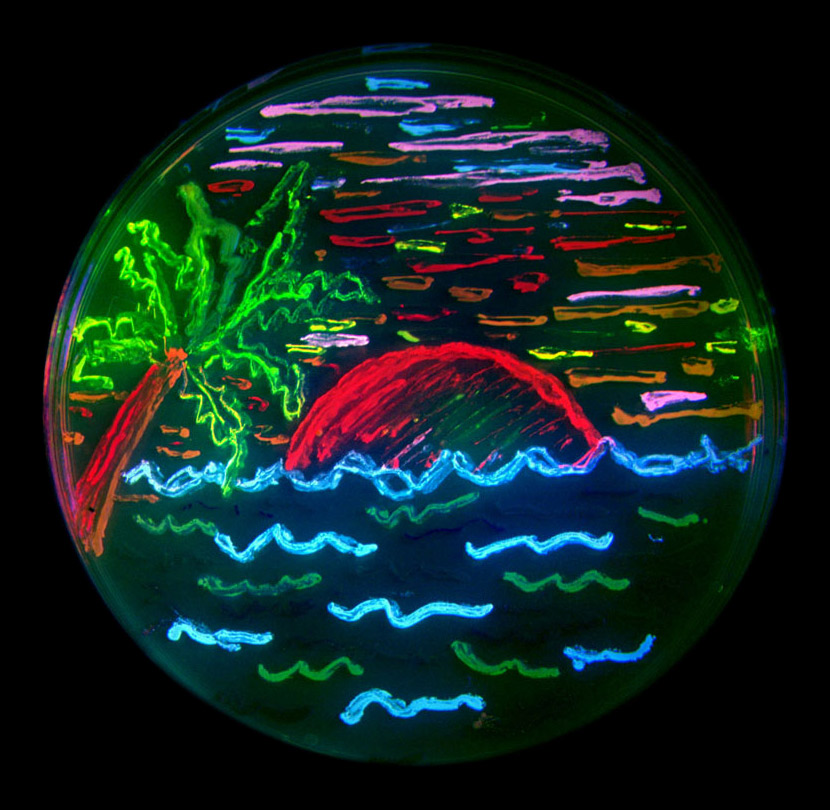
So why is the discovery of GFP relevant science? It’s a tool that has tremendously sped up many aspects of research in health-related fields. New generations of fluorescent molecules offer even more real-life applications: some labs are working on making tumors glow for easier surgical removal. So next time you see a jellyfish laying on the beach, resist the urge to poke it with a stick (so hard, I know...). It is making a great contribution to health research. It also allows bored scientists to make really cool works of art:

A San Diego beach scene drawn with an eight color palette of bacterial colonies expressing fluorescent proteins derived from GFP and the red-fluorescent coral protein dsRed. The colors include BFP, mTFP1, Emerald, Citrine, mOrange, mApple, mCherry and mGrape. Artwork by Nathan Shaner, photography by Paul Steinbach, created in the lab of Roger Tsien in 2006.


© 2009 Scientific Chick. All Rights Reserved | Powered by Blogger
Design by psdvibe | Bloggerized By LawnyDesignz